What is CIPHER?
Linear Response Theory
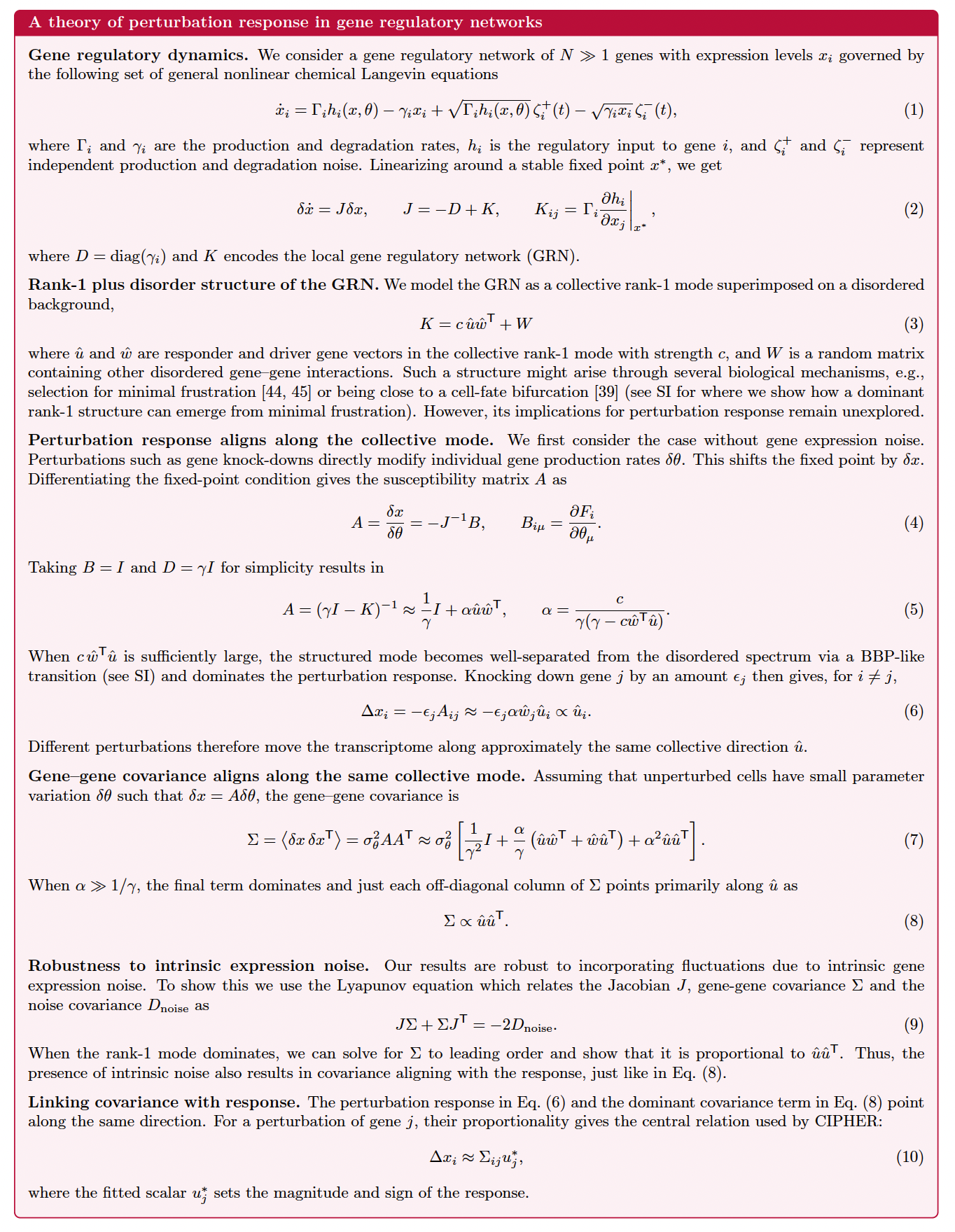
Linear response theory is a mathematical framework used to describe how a system responds to small perturbations. In physics, it is often used to model the behavior of systems near equilibrium, where the response of the system is proportional to the applied perturbation, including Marcus theory of electron transport and Onsager’s reciprocal relations.
Assumption
Linear response theory assumes that the response of the system is proportional to the magnitude of the perturbation, allowing researchers to predict how gene expression will change in response to different perturbations.
CIPHER: Covariance Inference for Perturbation and High-dimensional Expression Response
In this work, we apply linear response theory and Bayesian inference in the context of perturbation biology and prove this mathematical formula can predict the post-perturbation transcriptional shifts - both for chemical and genetic perturbations.
We apply linear response theory mainly by the following formula:
where X is the gene expression profile of a cell, < X > is averages of gene expression X, u is the perturbation vector, and ∑ is the susceptibility matrix that describes how the system responds to the perturbation. The susceptibility matrix can be estimated from experimental data or theoretical models, and it captures the relationships between different genes and their responses to perturbations. Subscript 0 indicates the unperturbed state (control cells), and subscript u indicates the perturbed state.
\[\Delta X = \langle X \rangle_u - \langle X \rangle_0 \quad \text{and} \quad \Sigma_{ij} = \langle \delta X_i \delta X_j \rangle \quad \text{for} \quad \delta X_i = X_i - \langle X_i \rangle_0\]
Forward Problem: Perturbation to Response
We define the forward problem as predicting the perturbed gene expression profile of a cell given a perturbation. In this case, we can use the linear response theory to predict the post-perturbation transcriptional shifts by applying the susceptibility matrix to the perturbation vector. Most virtual cell models, including CellOT, CPA, GEARS, and AttentionPert, solve this forward problem.
Reverse Problem: From Response to Perturbation
We define the reverse problem as inferring the perturbation vector given the observed perturbed gene expression profile of a cell. In this case, we can use Bayesian inference to estimate the perturbation vector that best explains the observed post-perturbation transcriptional shifts, given the susceptibility matrix and the unperturbed gene expression profile. To our knowledge, this reverse problem has not been solved by any of the existing virtual cell models. CIPHER is the first model that can solve this reverse problem in perturbation biology.
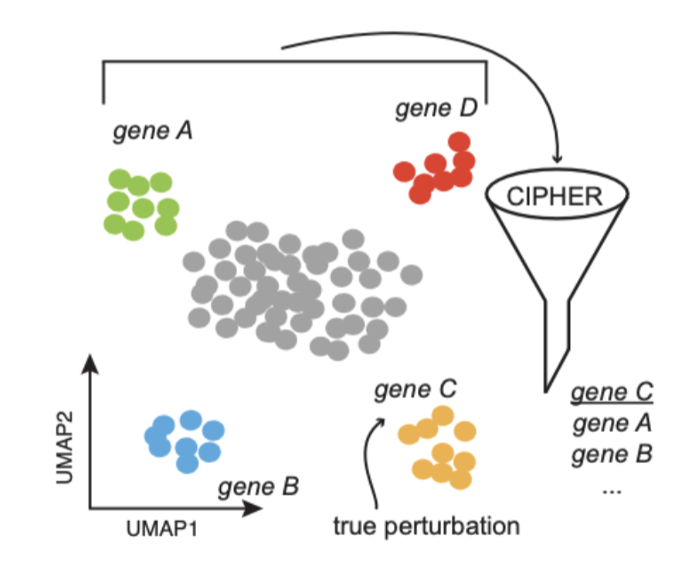
Schematic of the reverse problems in perturbation biology. CIPHER is analogous to a funnel that filters out the perturbation vector from the observed perturbed gene expression profile of a cell.